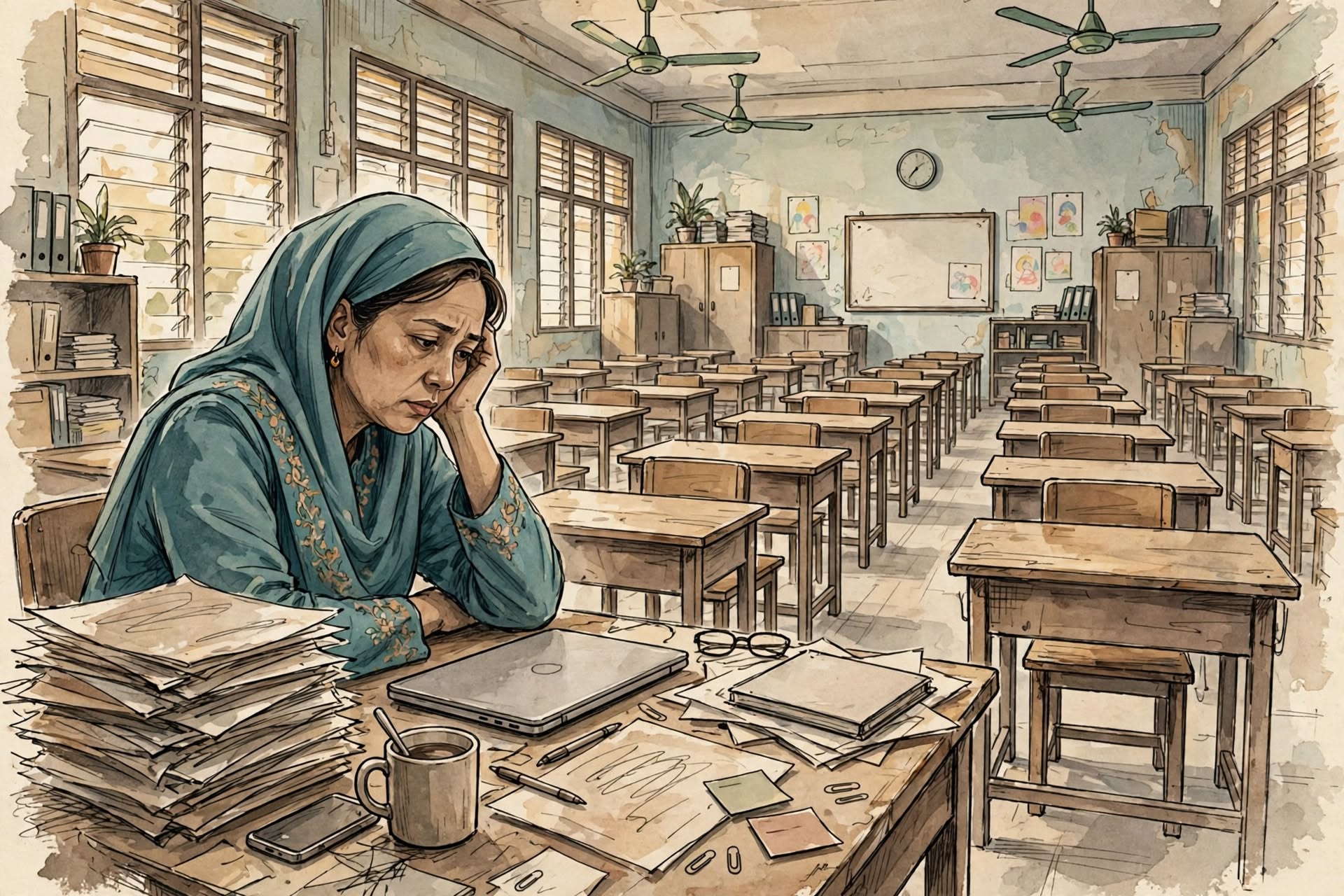
Responsible for Everything, In Control of Little: Why Malaysian Government School Teachers Are Burning Out
Teachers in Malaysian government schools are not burning out because the work is hard. They are burning out because they are held responsible for results they are not allowed to control.
Ask most cikgu what drains them and the answer is rarely the murid. It is the gap between what they are expected to deliver and what they are given to deliver it. Accountability keeps rising. Authority, staffing, and time do not.
In the KPM system, that gap is structural.
1. Responsibility without control in a KPM school
In most jobs, the person accountable for an outcome gets a say in the conditions that produce it. In our schools, that link is broken.
Workplace researchers have been describing this for decades. In 1979, Robert Karasek proposed that stress at work depends not only on how much you have to do, but on how much say you have over it. The most damaging combination in his model was heavy demands with little control over how and when the work gets done. Jobs that are just as demanding but come with real control tend to be far less harmful, and can even keep people motivated [33].
Teaching in Malaysian government schools seems to fit that first description uncomfortably well. The World Bank was already calling our system one of the most centralised in the world back in 2013 [34]. Even principals work as civil servants inside that hierarchy, and when the 2013 Blueprint promised schools more autonomy, hiring teachers was never part of it [35]. Postings, the curriculum, assessment formats and most deadlines come from above. If the principal has limited room to move, the teacher in 4 Bestari has even less.
That may be why advice about time management and resilience often lands badly in the staffroom. It isn't bad advice. It just assumes teachers have more control over their day than most actually do. Karasek's own paper was about redesigning jobs, not fixing the people in them.
A teacher in SK or SMK answers for student growth, discipline, and wellbeing. Yet the levers that shape those outcomes sit elsewhere: who is in the class decided by enrolment, how many adults in the room decided by perjawatan, how the timetable is built decided by pentadbir and arahan JPN/PPD, and what resources arrive decided by allocation.
The teacher is expected to close the gap with effort alone. This is not a time-management problem. It is a design problem.
2. Where it shows up every day in SK and SMK
a) Student growth vs class size
You are held responsible for PBD, literacy, numeracy, and closing learning gaps. But you don't control class size.
In the Klang Valley and Johor Bahru, some schools now put 40 to 45 pupils in one class [1]. In Melaka, 49 of the 53 schools getting new IBS classrooms were already over capacity, with more than 35 pupils per class, and the 2027 double intake of six- and seven-year-olds will add pressure [1]. Rural schools face the opposite problem. Perak has 252 under-enrolled schools with fewer than 150 pupils in 2026, some with only five to seven [2]. There, one teacher often handles multi-level, multi-subject recovery.
A class of 40 changes what a teacher can realistically do. Most of us were trained on some version of Vygotsky's idea that children learn best on work just beyond their reach, with an adult helping them through the next step. That help happens one child at a time. With 40 pupils in a 60-minute lesson, even if the teacher spent every minute on individual help, each child would get about a minute and a half.
PBD makes this harder to ignore. The teacher is supposed to watch each pupil, decide their tahap penguasaan and adjust the next lesson. With 25 pupils that is demanding but doable. With 40 or 45, the teacher is constantly choosing who gets attention today and who waits until next week. That matters, because the feedback is where most of the value lies. Black and Wiliam's well-known review of formative assessment found strong gains when it is done well, largely through specific feedback on each pupil's own work [29].
Class size research is more contested than people sometimes assume, but the best-known experiment is hard to dismiss. In Tennessee's Project STAR, children were randomly placed in early-grade classes of either 13 to 17 or 22 to 25 pupils. The smaller classes did noticeably better [30], and researchers later linked them to higher rates of graduation and college enrolment [31]. Many of our urban classes are close to double STAR's "regular" size, yet teachers are still expected to teach the way that research recommends.
Either way, individualised pedagogy is expected, but the numbers make it heroic.
b) Student behaviour vs safety support
You are responsible for classroom behaviour and for inclusion of murid berkeperluan khas. But you don't control safety support when behaviour becomes unsafe.
Discipline is probably where this shows most clearly. Bullying cases logged in SSDM went from 3,883 in 2022 to 7,681 in 2024 [22]. KPM puts some of that rise down to better reporting since SPI Bil. 12/2023 [23], which is fair. Still, somebody has to receive each report, look into it and write it up, and that somebody is usually a teacher. Occasionally it turns physical. In June 2026, a Guru Disiplin in Perak was reportedly attacked by a group of students after telling them their hair was too long [24].
Teachers are also unsure where their authority ends. iGuru has pointed out that under child protection law teachers cannot physically touch pupils, and has called for an act that legally protects the teaching profession [25]. KPM has since said principals may delegate disciplinary powers to teachers, and that the discipline regulations are being redrafted [26].
Even with those powers, procedure and paperwork remain at the core of every disciplinary action. When a pupil clearly deserves consequences for bullying or truancy, the Guru Disiplin still has to record the case in SSDM, take statements, contact and meet parents, issue warning letters in sequence, and keep a file that will hold up if the family complains or the case goes viral. Documentation matters, and no one is arguing that teachers should skip it. But a Guru Disiplin is still a regular teacher with a full timetable, not a detective or an investigating officer.
Then there is inclusion. Under the Program Pendidikan Inklusif, murid berkeperluan khas join mainstream classes, and few would argue against that in principle. Preparation is the harder part. A study of mainstream primary teachers in Selangor rated their readiness as only moderate [27], and others report having had little training in handling these pupils [28]. A teacher can fully believe in inclusion and still not know what to do when a pupil with autism has a meltdown halfway through a lesson on fractions.
Most kelas perdana have one teacher and no classroom assistant. Pembantu Pengurusan Murid (PPM) posts serve preschool and PPKI classes [3]. The counsellor norm is one per 500 secondary pupils [4], and KPM admits its target of 1:250 has not been met [5]. When a case escalates, the paperwork falls back on the class teacher and Guru Disiplin.
c) Differentiated teaching vs staffing
You are expected to do differentiation, pemulihan, RPI, DLP, and literacy and numeracy intervention for many levels.
It helps to know how many children we are talking about. In the 2024/2025 session, KPM found 122,062 Year 1 pupils, about 27.5% of the cohort, who needed help with literacy and numeracy. More than 62,000 of them were at TP1, the lowest level. The minister pointed to learning lost during the pandemic, poverty and special needs [19].
Much of that work lands on ordinary subject teachers. KPM describes support for these pupils as a joint effort between subject teachers and Pemulihan Khas teachers [20], and the programme has also leaned on IPG trainees, matriculation students and community volunteers [21]. Take a Year 1 BM teacher with 35 pupils. In a single period she may be teaching the main lesson, running a small pemulihan group at the back, and noting PBD levels for both.
Differentiation sounds straightforward in a PdPc course: adjust the task to where each pupil is. Mastery learning adds another condition, that nobody moves on until they have actually got the current skill. Both are good ideas. Both also assume a teacher can keep checking on individual pupils and reteaching the ones who haven't got it yet.
Benjamin Bloom saw the cost of this back in 1984. He reported that pupils taught one-to-one with mastery learning did better than 98% of pupils in ordinary classes of about 30 [32]. He framed it as a problem because nobody can afford a tutor for every child. Pemulihan Khas is, in a sense, our attempt to get closer to that for the pupils who need it most. When those pupils end up back with a subject teacher and a full class, we are quietly hoping for something close to tutoring results with ordinary classroom staffing.
But the staffing never matched the policy. In 2023, NUTP said schools were short 20,000 teachers because retirees were not being replaced fast enough [6]. In 2025 it was still calling for 10,000 teachers urgently [7]. KPM's relief measures, including 20,997 SPM exam volunteers, MySTEP teacher assistants, and full-time hostel warden assistants, only began in 2023 [8]. For a long time, differentiation meant "cikgu usaha lebih".
d) Communication vs boundaries
You are responsible for parent communication. But you don't control the expectation of constant availability.
It is now normal for one teacher to manage 2-3 WhatsApp groups for parents, Telegram groups for kelas, plus Google Classroom, DELIMa, and SAPS updates. NUTP lists handling parents' WhatsApp groups among the workload issues teachers raise with the union [9].
And then there is SISPAA, the public complaints system. NUTP says baseless complaints against teachers are rising, and a pending complaint can stall a teacher's promotion [10]. The union has asked KPM to screen complainants before a full investigation [10] and to require an interview with the complainant first [9]. You are accountable 24 hours, but you cannot set boundaries.
e) Documentation vs planning time
You are responsible for documentation. But planning time is consumed by everything else.
Teachers juggle IDME, e-RPH, SKPM Kualiti@Sekolah pencerapan [16] and others. The same data often has to be entered into multiple systems. Even e-RPH, which was supposed to be digital, came with a directive to print it weekly until teachers pushed back and KPM withdrew it in May 2025 [11].
The other killer: mesyuarat and taklimat so frequent they disrupt lesson preparation [9]. Relief classes, PLC, LADAP, kursus anjuran PPD/JPN during waktu PdP, kejohanan MSSD, keceriaan, gotong-royong, audit files. In one 2025 study, 41% of teachers said their school administration's support on workload and burnout was ineffective [12].
None of these is unreasonable on its own. The trouble is that they all eat the same hours. A colleague goes on a course, or to a meeting, or on leave, and their classes turn into relief periods for whoever happens to be free. NUTP has said some schools have as many as 20 teachers out on a given day for these reasons [17], and in 2025 it asked for more funding for substitute teachers so permanent staff are not always the ones covering [18].
Picture a fairly normal day. The free period after recess was meant for marking, but a colleague is out, so it becomes relief. There is a meeting at 2.30. That night, a parent messages about tomorrow's homework. The marking waits for the weekend. KPM's 2023 decision to drop low-impact competitions and events [14] shows it understands some of this. Applying the same test to meetings, courses and relief duty would be a sensible next step.
3. The blame reflex - Malaysian edition
One small 2025 survey of 100 Malaysian teachers gives a sense of what they are dealing with: 70% named paperwork and documentation as a major source of stress, followed by extracurricular workload at 61% and student discipline at 50% [12].
Scroll through teacher posts on Facebook, TikTok or Threads and the same frustrations come up, often with a fair amount of public sympathy. In 2024, a teacher asked why parents kept messaging to check homework for Year 4 pupils, and plenty of netizens sided with the teacher [36]. In July 2026, a teacher who told a disruptive student to pack up and go home was mostly praised in the comments [37]. Another teacher wrote that he had been transferred after confiscating students' vapes and phones, and that he had lost his passion for teaching. Former teacher and activist Mohd Fadli Salleh shared the post as an example of how far the job now reaches beyond the classroom [38].
The mood can turn quickly, though. In 2024, a TikTok trend had students claiming that their teachers' attitude was what made them lazy [39]. A few days ago, after a teacher's classroom comedy video went viral, some netizens said they had lodged SISPAA complaints and asked the minister to step in [40]. Commentators also note that many graduates now see teaching as stressful and bureaucratic, and that too few young Malaysians are choosing it [41]. Online, teachers tend to be cast as heroes or suspects. The ordinary version, someone doing a hard job in difficult conditions, gets far less attention.
When results fall short, the first question is: What did cikgu fail to do? Rarely: What did the system fail to provide?
If PBD or SPM results drop, blame the teacher's technique. If a discipline case goes viral, blame the teacher's control. If a SISPAA complaint comes in, the teacher must explain first. Between 2022 and May 2025, 19,179 teachers took early retirement, and two-thirds cited loss of interest in teaching [13].
The result is not loud anger. It is quiet, constant rasa tak cukup. Not because teachers are failing, but because the job was set up so that success is out of reach for one person.
4. Match accountability with support - what it looks like in KPM
Accountability is part of teaching. Most Malaysian teachers accept that. The fix is not less accountability. It is accountability that comes with the means to meet it.
KPM itself has acknowledged this direction. The Malaysia Education Blueprint (RPM) 2026-2035 sets an 80:20 policy: 80 percent of subject teachers' time for PdP, 20 percent for non-teaching tasks [8]. In 2023, Minister Fadhlina announced seven measures, including abolishing low-impact events and cutting SKPM reviews involving teachers to once a year [14]. In December 2025, KPM went further and abolished SPLKPM, the training management system teachers had long complained about [15].
That is the right direction, but teachers on the ground are asking for the next step - what iGuru calls "One In, One Out": every new task must replace an old one [9].
As iGuru president Mohd Azizee Hasan put it: "Teachers do not actually mind carrying out additional responsibilities. However, they hope every assigned task provides clear added value to students' learning" [9].
For a government school, that means:
1. Authority: Give Guru Mata Pelajaran a say in class size cap and inclusion placement. Not just to accept senarai nama.
2. Staffing that makes differentiation realistic: Permanent PPM for lower primary and classes with high-needs inclusion, and permanent teaching assistants instead of short-term MySTEP contracts. You cannot differentiate 40 pupils with 5 levels alone.
3. Protected planning time: No mesyuarat during waktu PdP unless emergency. Mark e-RPH, RPT, and PBD as core work. Everything else as 20 percent.
4. Communication boundaries: One official channel per class. SISPAA needs SOP reform - complainants interviewed and verified before investigation, as NUTP has proposed [9][10]. WhatsApp group is not a 24-hour hotline.
5. Lighter documentation: One entry, one system. If data is in APDM, don't ask for it again in SMM, SPS, and manual filing. Keep only what genuinely helps murid.
When expectations and support rise together, cikgu can do the job they trained for - mengajar.
A final thought for Malaysian schools
Thousands of cikgu have already chosen to leave early. KPM has started to lighten the load, and the 80:20 policy points the right way, but a policy only counts when the classroom feels it. If we want teachers to stay in SK and SMK, we have to stop asking them to carry outcomes alone. Every new expectation must arrive with the authority, people, and time to meet it.
Otherwise, we are not holding teachers accountable. We are setting them up to fail in front of 40 students, 40 parents' WhatsApp messages, and 5 different data systems - and then asking why they left.
Sources
- Bilik khas kembali fungsi asal menerusi pembinaan kelas IBS (Bernama, Sep 2026)
- 252 sekolah di Perak kurang murid (Bernama, Jan 2026)
- PPM and PPM PPKI roles (Jurnal Pendidikan Awal Kanak-Kanak Kebangsaan, 2020)
- Data kaunseling sekolah (Dewan Negeri Selangor, 2026)
- KPM sasar capai nisbah 1:250 guru kaunseling (Buletin TV3, Oct 2024)
- Schools facing shortage of 20,000 teachers, says NUTP (FMT, Sep 2023)
- NUTP calls for 10,000 teachers (Education International, Jul 2025)
- Malaysia Education Blueprint 2026-2035 to tackle teachers' workload (Bernama, Mar 2026)
- 'One In, One Out' antara cadangan kawal beban tugas guru (The Merdeka Times, Aug 2026)
- Jangan jadikan Sispaa alat tekan guru, kata NUTP (FMT, Dec 2025)
- Guru tidak perlu cetak e-RPH setiap minggu (Bernama, May 2025)
- Teaching on the Edge: How Workload Drives Burnout among Malaysian Educators (IJARBSS, 2025)
- Loss of interest main reason behind teachers' early retirement (FMT, Aug 2025)
- KPM laksana 7 langkah atasi beban tugas guru (Sinar Bestari, Feb 2023)
- KPM mansuh SPLKPM (Bernama, Dec 2025)
- SKPM Kualiti@Sekolah replaces SKPMg2 (JNJK briefing, 2024)
- NUTP: Shortage of teachers a 30-year problem (Twentytwo13, Jun 2023)
- NUTP pushes for MoE task force to tackle workload crisis (Malay Mail, Jul 2025)
- Wajarkah kuasai 3M sebelum masuk Tahun Satu (Sinar Harian, Oct 2024)
- Penguasaan 3M murid sekolah rendah capai 97 peratus (Malaysia Gazette, Jan 2026)
- Program Pemulihan Khas dilaksana di sekolah rendah (Berita RTM)
- Kes buli sekolah meningkat, hampir 70 peratus libat pelajar menengah (Buletin TV3, Feb 2026)
- KPM dedah statistik: 2,889 kes buli, 3,570 salah laku jenayah (Langit News, Feb 2026)
- Kes murid dibuli, guru disiplin ditumbuk dalam perhatian KPM (Buletin TV3, Jun 2026)
- Kes disiplin sekolah: Kembalikan kuasa guru (TV Pertiwi, Oct 2025)
- KPM laksana langkah tambahan perkukuh keselamatan sekolah (Nabalu News, Oct 2025)
- Tahap kesediaan guru aliran perdana dalam pelaksanaan PPI sekolah rendah di Selangor (IJEPC)
- Tahap kesediaan guru arus perdana terhadap pengajaran MBPK (JQSS, Jun 2025)
- Black & Wiliam, Inside the Black Box: summary (Great Schools Partnership)
- Mosteller, The Tennessee Study of Class Size in the Early School Grades (Future of Children, 1995)
- Figlio & Schanzenbach, class size evidence review (Illinois State Board of Education)
- Bloom, The 2 Sigma Problem (Educational Researcher, 1984)
- Karasek, Job Demands, Job Decision Latitude, and Mental Strain (Administrative Science Quarterly, 1979)
- Schools should be decentralised, says World Bank (FMT, Dec 2013, via reprint)
- Bush et al., school leadership in Malaysia's centralised system (University of Nottingham)
- 'Hari-hari tanya homework, siapa datang sekolah sebenarnya?' Luahan guru tular (SinarPlus, Mar 2024)
- Tindakan berani guru ajar murid biadab dipuji (mStar, Jul 2026)
- "I lost my passion to teach": teacher relocated allegedly for confiscating vapes (World of Buzz, Dec 2025)
- Trend 'Kami bukan malas, tapi sikap guru buat kami malas' (The Rakyat Post, May 2024)
- Ramai kritik cikgu wanita buat konten (BuzzKini, Sep 2026)
- The silent crisis in Malaysia's teaching profession (Focus Malaysia, May 2026)